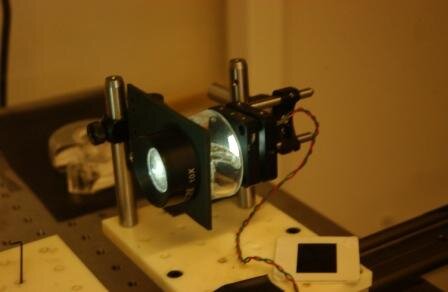
Cornea glare test instrument for MEEI
This custom built instrument will allow Dr. Rony Sayegh at the MEEI (Mass Eye and Ear Infirmary, Boston, MA) to improve the sight of his patients. Dr. Sayegh has developed a cornea implant called the Boston KPro (here’s a link to the wiki article about it: http://en.wikipedia.org/wiki/Boston_keratoprosthesis). In order to continue improving this design, we supported Dr. Sayegh with this instrument. Using a carefully aligned LED source and a rotational camera mount, in a light tight enclosure, the glare of various new cornea implant designs can be tested and evaluated.
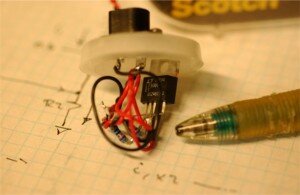
We were able to deliver a custom instrument for reasonable cost and effort by using a combination of custom parts (mostly laser cut plexi from Danger Awesome in Cambridge, a link to their website here: http://dangerawesome.co/ ) and off the shelf mechanical/optical components from Thor Labs (http://www.thorlabs.com/).
Pete
LED current source based on LT3080, the modern LM317 replacement part, runs off USB or 9V or any voltage in between
Posted by Michael Beach in Uncategorized on July 7th, 2012
This 20mA current source will operate from a USB 5V power supply. Using the LT3080 linear regulator makes it easy to get good voltage headroom. Only 200mV is needed in this version to sense the LED current – the old venerable LM317 required 1.25V just to get started – and that’s not including any drop-out voltage of the pass transistor.
Here’s a link to the schematic, in pdf format, showing some details of the voltages and operating ranges.
USB_LED_Current_Source_16FEB2012_REV-0.sch
Blue LEDs make healthy babies – Firefly Phototherapy from Design That Matters
Posted by Michael Beach in optics, photo, prototype on June 6th, 2012
At an early stage in this project, Pete provided measurements and guidance about the most effective LED optics for the jaundice cure for new born babies. Full project description can be found at the Design That Matters website here. Uniform light with the fewest LEDs, to reduce cost and insure effective treatment.
Eye exam using a smart phone, and some plastic optics – the NETRA project
Posted by Michael Beach in metrology, optics, parts, prototype on June 6th, 2012
Pete has been working with some folks at the MIT Media Lab, in particular the Camera Culture Group of Ramesh Raskar. Using the display on the smart phone, and some pinholes and plastics, you can interact with the phone and measure your prescription and astigmatism. Link to project description at MIT Media Lab
There is a new start-up spin off company called Eye-Netra, that can be found here.
Here’s Pete demonstrating the clumsy kit that Eye Netra will replace:
Energy Harvesting – battery-free radio
Posted by Michael Beach in energy, energy harvesting, how-to, prototype, video on June 6th, 2012
We’re working on some energy harvesting projects – and we learned about this amazing project – a radio powered only by the sound of the voice of the person talking at the transmit end.
El Silbo, voice powered radio design by MJ Rainey
This was able to transmit 150 miles with NO batteries at all. And no ‘super caps’ either. Just the transient power of his voice. Michael Rainey provides a schematic here: Schematic of voice powered transmitter, El Silbo.
The trick for using a speaker as a microphone to absorb sound wave power is to get a good step-up transformer. The speaker has current, but little voltage, even into a high impedance. Of course, you can get more power output using the tin can approach, demonstrated in this video:
high voltage testing of 208VAC phase controller used on semiconductor production equipment
Posted by Michael Beach in how-to, methodology on June 5th, 2012
This phase controller uses the tried and true back to back SCR technique. It’s and old unit but still in service, partly due to our repairs and system debug. About half the gear in the photo is our test jig. Watch out for ‘flux doubling’ when you turn on/off that big toroid transformer! We kept blowing the 20A breaker until we set up the variac on our bench set up.
client action photo
Posted by Michael Beach in optics, photo, prototype on June 5th, 2012
Here’s a couple of our clients puzzling over some lens test data. This was an exciting day, to see this huge lens tested! The puzzling was over by the end of the day, but this is a better action shot.
photos of recent work
Posted by Michael Beach in optics, prototype on June 5th, 2012
plausible, feasible, tangible
Posted by Michael Beach in methodology on September 16th, 2011
What we do always involves these three phases:
Is it plausible? Does your idea violate any known physical laws? Are you asking for a new light bulb that has 110% efficiency? If it passes the plausible test, we go to the next phase:
Is it feasible? Can your product be made, given a reasonable budget in a reasonable time frame? Often the ‘existence proof’ of a similar technology or device can help us answer this with minimal effort. Or we build a prototype to test the most tricky aspect – this becomes an object that can be tested, used, and evaluated, which brings us to the third phase:
Here it is. It’s tangible. A prototype, a ‘proof of principle’, a first example that shows what kind of performance and cost can be expected. Something you can use. This is a way to find the ‘slap on the forehead’ mistakes, and find them early in the project. Before you waste a lot of time, effort money on tooling, marketing, etc.
In the next weeks I’ll be writing about more specific examples of this process flow.
in the future, robots will have arms
Posted by Michael Beach in metrology, photo, prototype on August 10th, 2011
the kind of arms to pick up things, not like the puny arms that a T-Rex has. That’s the word we hear from Bec Conrad, who’s taking a break from her work with animatronic dinosaurs (see this link here: http://www.dinosaurlive.com/funstuff/).
Bec is helping us make this motion stage, based on a salvaged DVD player, a platform for some new precision products. With an encoder capable of 15um resolution from Austria Micro, and controls theory support from Bec, we look forward to using this prototype in our shop to improve our optical measurements.